
660nm Red Light and Mitochondria: Science for Tired Eyes
Research shows 660nm light reactivates cytochrome c oxidase in retinal cells, lifting ATP and contrast sensitivity. Here is the science behind the trials.
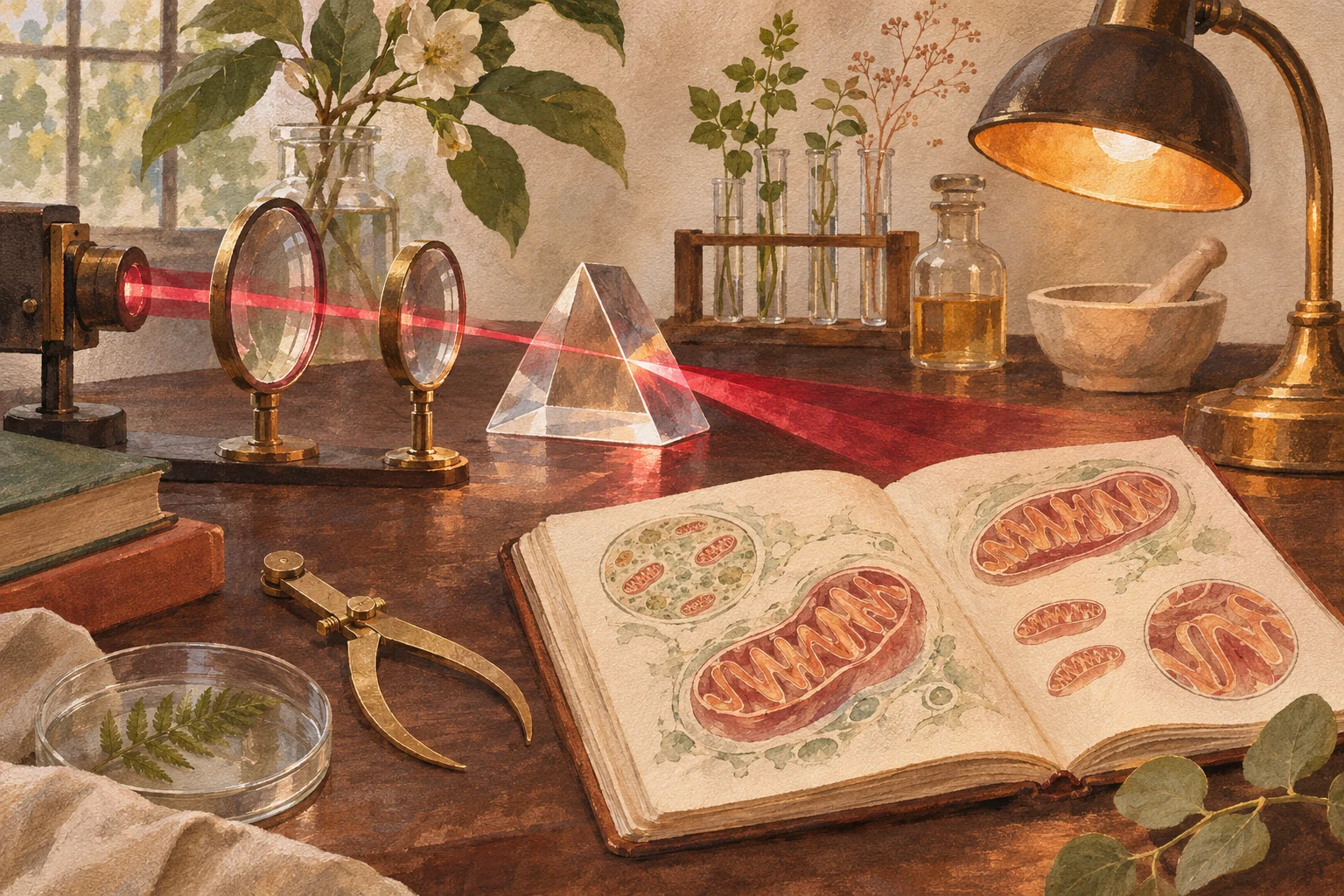
Short answer Clinical trials show that 660nm to 670nm red light targets cytochrome c oxidase within retinal mitochondria, photodissociating inhibitory nitric oxide and boosting ATP production by up to 20 percent. A three minute morning exposure at 8 mW/cm² enhances color contrast sensitivity and reduces visual fatigue in adults over forty, where cellular energy reserves naturally decline.
Retinal photoreceptors consume more adenosine triphosphate per gram than cardiac muscle cells. By age forty, retinal mitochondrial function drops by roughly thirty to forty percent, directly reducing the energy available to pump ions, clear oxidized photopigments, and repair daily light damage. When prolonged screen time forces the ciliary muscle into constant contraction under harsh blue light, this existing cellular deficit produces burning, dry, and heavy eyes by late afternoon.
Why do retinal photoreceptor cells demand so much mitochondrial energy?
Rod and cone cells do not rest in the dark. In darkness, photoreceptor outer segments keep sodium and calcium channels open, requiring continuous sodium-potassium ATPase pump activity to maintain membrane potential.
This continuous dark current requires immense quantities of adenosine triphosphate, generated inside thousands of tightly packed mitochondria inside the inner segment. Because the retina has such high metabolic turnover, it generates high levels of reactive oxygen species that slowly damage mitochondrial DNA.
In preclinical models of retinal stress, interventions targeting this metabolic decline show substantial preservation of photoreceptor survival [1]. When energy production drops, the retina loses color contrast sensitivity first, particularly across the tritan, or blue-yellow, color axis.
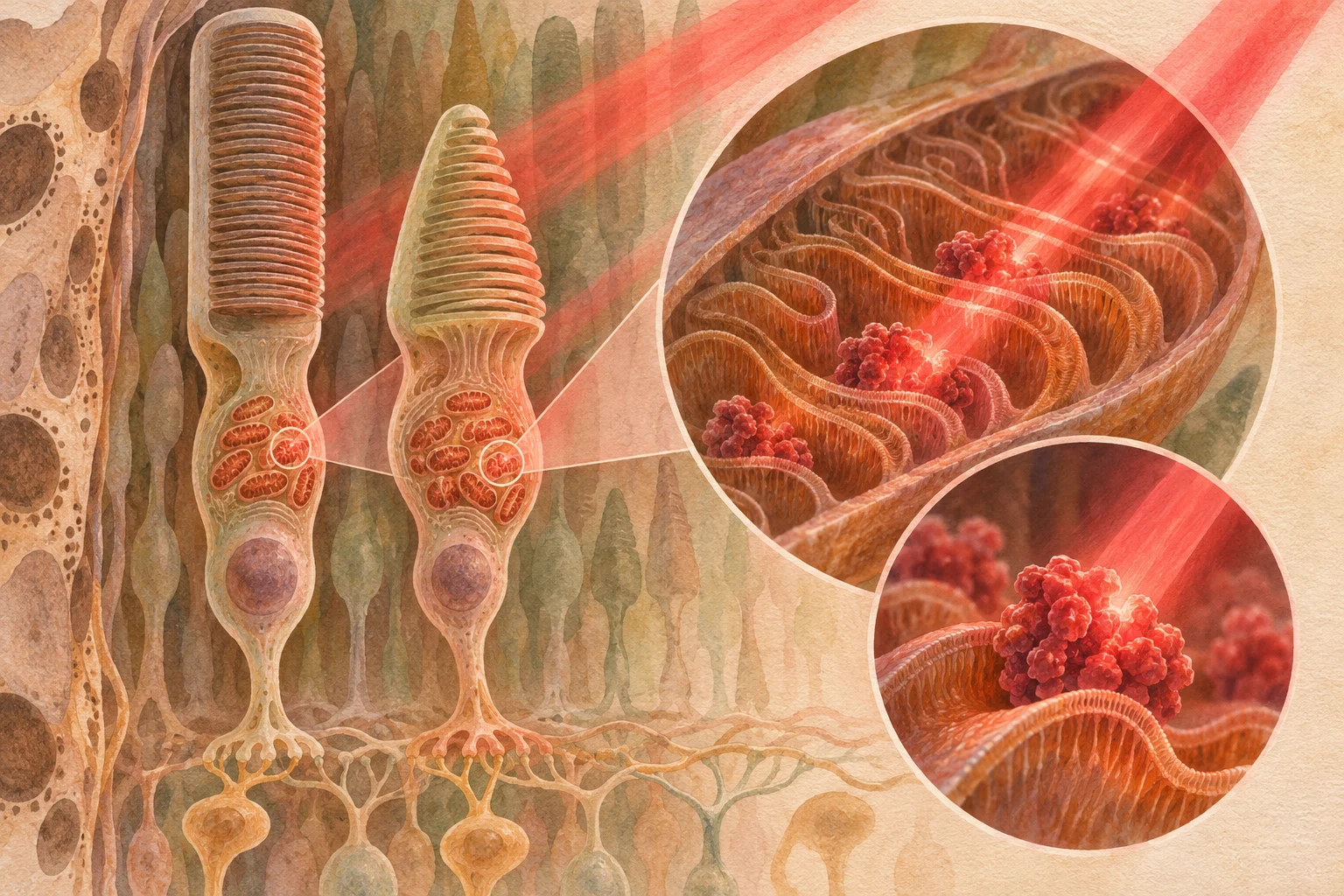
How does 660nm light reactivate cytochrome c oxidase?
Photobiomodulation relies on endogenous photoacceptor molecules capable of absorbing specific wavelengths. Within the electron transport chain, complex IV, known as cytochrome c oxidase, acts as the primary chromophore for red and near-infrared light.
Cytochrome c oxidase contains two copper centers and two heme iron centers that exhibit peak light absorption between 630nm and 670nm, as well as between 800nm and 850nm. During sustained ocular strain or metabolic aging, nitric oxide binds to these catalytic centers, competitive with oxygen, halting the movement of electrons down the respiratory chain.
Absorption of 660nm photons excites electrons within the copper-heme prosthetic groups, breaking the nitric oxide bond. Once nitric oxide dissociates, oxygen binds to complex IV again, increasing mitochondrial membrane potential, accelerating the proton gradient, and driving adenosine triphosphate synthesis [2].
Why does the timing of red light exposure alter clinical results?
Clinical researchers at University College London exposed participants aged thirty-eight to seventy to 670nm light at an irradiance of 8 mW/cm² for three minutes. When subjects received this three-minute dose between 8:00 AM and 9:00 AM, color contrast thresholds improved by seventeen to twenty percent, with benefits persisting for up to a week from a single exposure.
When the identical protocol was administered between 12:00 PM and 1:00 PM, no measurable improvement in visual performance occurred. Retinal mitochondrial respiration follows an endogenous circadian cycle, peaking during morning hours when photoreceptor outer segments undergo daily phagocytosis and shedding.
Stimulating complex IV during this morning activation window produces a lasting metabolic reset. Systems-level research in central nervous tissue confirms that photobiomodulation works in tandem with daily neurobiological rhythms, enhancing cellular resilience and quality of life when matched to natural cycles [3].

How do different wavelengths compare for retinal support?
Not all spectral bands affect ocular tissues equally. Wavelength dictates both tissue penetration depth and the specific molecular chromophore that absorbs the light energy.
| Wavelength Band | Primary Target / Chromophore | Mitochondrial Effect | Clinical Ocular Outcome |
|---|---|---|---|
| 415nm to 455nm (High-Energy Blue) | Flavins, lipofuscin, opsin intermediates | Generates reactive oxygen species, stalls complex I | Contributes to photochemical damage, ciliary spasm, and visual fatigue |
| 520nm to 540nm (Green) | Rhodopsin, melanopsin, opsin pigments | Minimal direct respiratory chain interaction | Calms trigeminal pain pathways, reduces migraine sensitivity |
| 660nm to 670nm (Deep Red) | Cytochrome c oxidase (CuA and CuB centers) | Photodissociates nitric oxide, raises ATP synthesis | Restores cone contrast sensitivity, relieves tired ocular muscles |
| 810nm to 850nm (Near-Infrared) | Cytochrome c oxidase, structured cell water | Alters water viscosity around ATP synthase rotors | Deeper penetration into choroid and retinal pigment epithelium |
While high-energy blue rays deplete ocular energy reserves, red wavelengths replenish them. Balancing your spectral exposure throughout the day is just as critical as managing nutritional fuel for systemic metabolism.
What practical steps protect eyes during long screen sessions?
Managing digital eye strain requires a two-sided strategy: shielding the retina from high-energy blue peaks while offering low-level red photobiomodulation to support cellular respiration.
Filtering artificial light in the late afternoon prevents unnecessary retinal oxidation, as detailed in our guide on do blue light glasses actually help you sleep. When working under intense fluorescent fixtures or monitors, wearing specialized eyewear like our red-light-glasses helps maintain retinal comfort and mitochondrial support by delivering calibrated 660nm wavelengths directly to resting photoreceptors.
For those who notice persistent evening headaches alongside screen-related visual fatigue, pairing targeted phototherapy with proper nighttime lens filtration can prevent disruptions to your circadian system, as discussed in amber vs red lens glasses: stopping melatonin suppression.
To build a consistent routine, start with three minutes of gentle 660nm exposure three mornings per week while seated at your desk. Keep the light source diffuse, avoid staring into point-source high-power LEDs, and allow your photoreceptor mitochondria to regenerate naturally under steady metabolic conditions.
Common questions
How does 660nm light interact with retinal mitochondria?
Photons at 660nm are absorbed by copper and iron centers in cytochrome c oxidase. This absorption releases bound nitric oxide, restoring oxygen binding and increasing adenosine triphosphate output.
Why is morning red light exposure more effective than evening exposure?
Retinal mitochondrial metabolism follows a strict circadian rhythm with high energy demands and synchronized biogenesis in the morning. Trials show morning exposures produce significant contrast improvements, whereas afternoon treatments show minimal benefit.
What dosage was used in clinical trials for visual fatigue?
Human trials conducted at University College London utilized an irradiance of 8 mW/cm² for three minutes once per week, delivering a total fluence of roughly 1.44 J/cm² to the retina.
Can I use standard red LED panels for retinal photobiomodulation?
Standard red light panels are often built for skin or muscle and emit irradiances far too high for comfortable direct ocular gazing. Retinal support requires calibrated, low-intensity diffuse light within the 660nm to 670nm band to prevent glare and thermal stress.
Mentioned in this article
 From the shop
Red Light Therapy Glasses 660nm
Medical-grade 660nm near-infrared. Eye comfort and cellular support without melatonin suppression.
See it →₹5,413