
Dark chocolate and brain blood flow: what cocoa flavanols actually do
Most 70% dark chocolate bars lose over half their flavanols before they leave the factory. Here is how epicatechin raises nitric oxide, what Dutch processing strips out, and what to read on the back label.
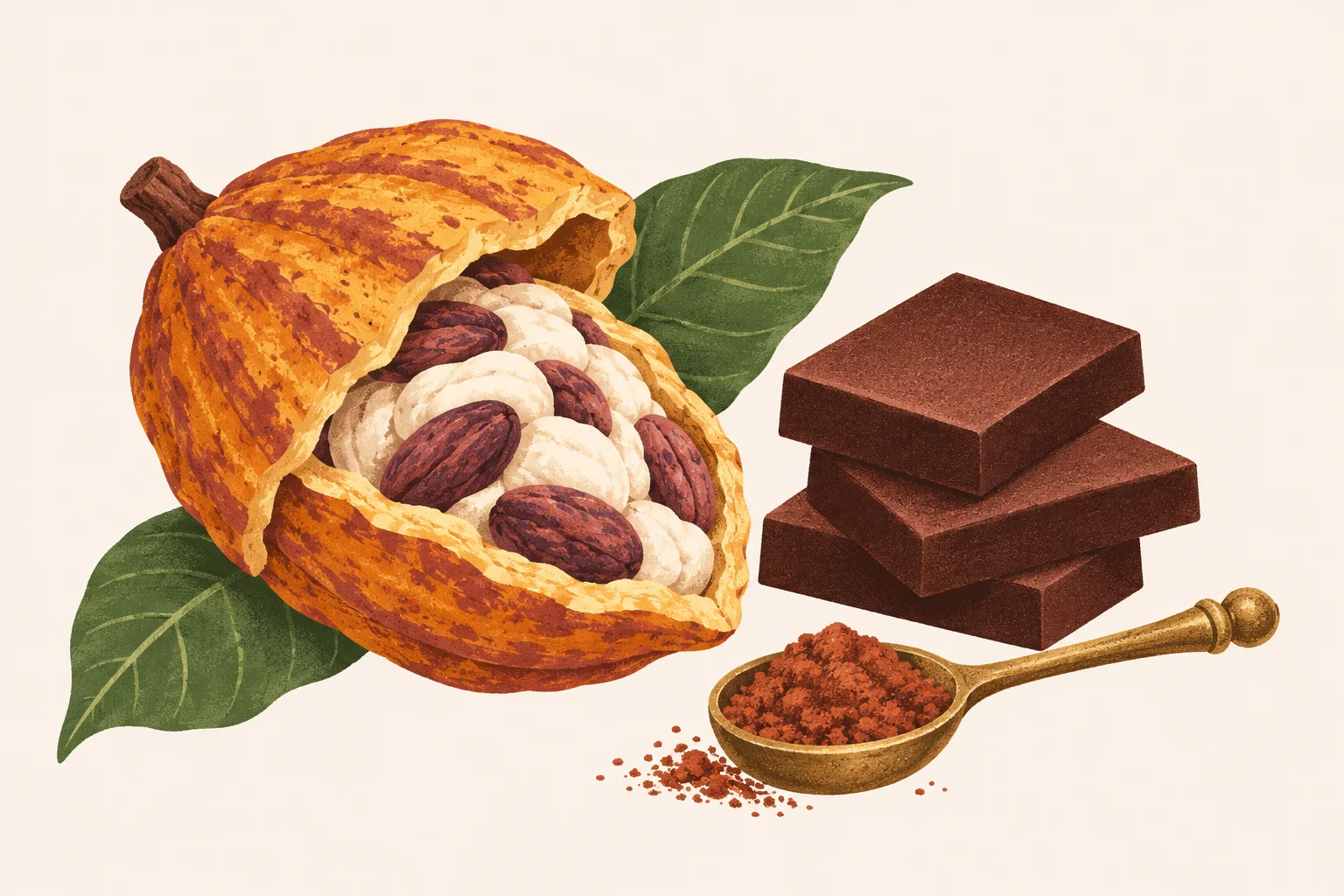
Short answer Unalkalized cacao contains epicatechin, a flavanol that signals blood vessel walls to release nitric oxide within 90 to 120 minutes of eating. That widens arteries and increases regional cerebral perfusion in human imaging trials. The catch is processing: Dutch alkalization strips 60% to 88% of those flavanols, and the 25% to 30% refined sugar in standard dark bars works against the vascular effect.
Walk down any grocery aisle and every 70% dark bar looks like heart medicine. The front label prints the cacao percentage in gold foil. Flip the wrapper over and the first or second ingredient is almost always cane sugar, followed by cocoa processed with alkali.
Those four words on the back label undo most of the reason people switch from milk chocolate to dark in the first place.
How do cocoa flavanols increase nitric oxide and blood flow?
Raw cacao beans are packed with monomeric flavanols, mainly epicatechin and catechin. When you eat non-alkalized dark chocolate, epicatechin is absorbed in the small intestine and reaches peak levels in the bloodstream about 90 to 120 minutes later.
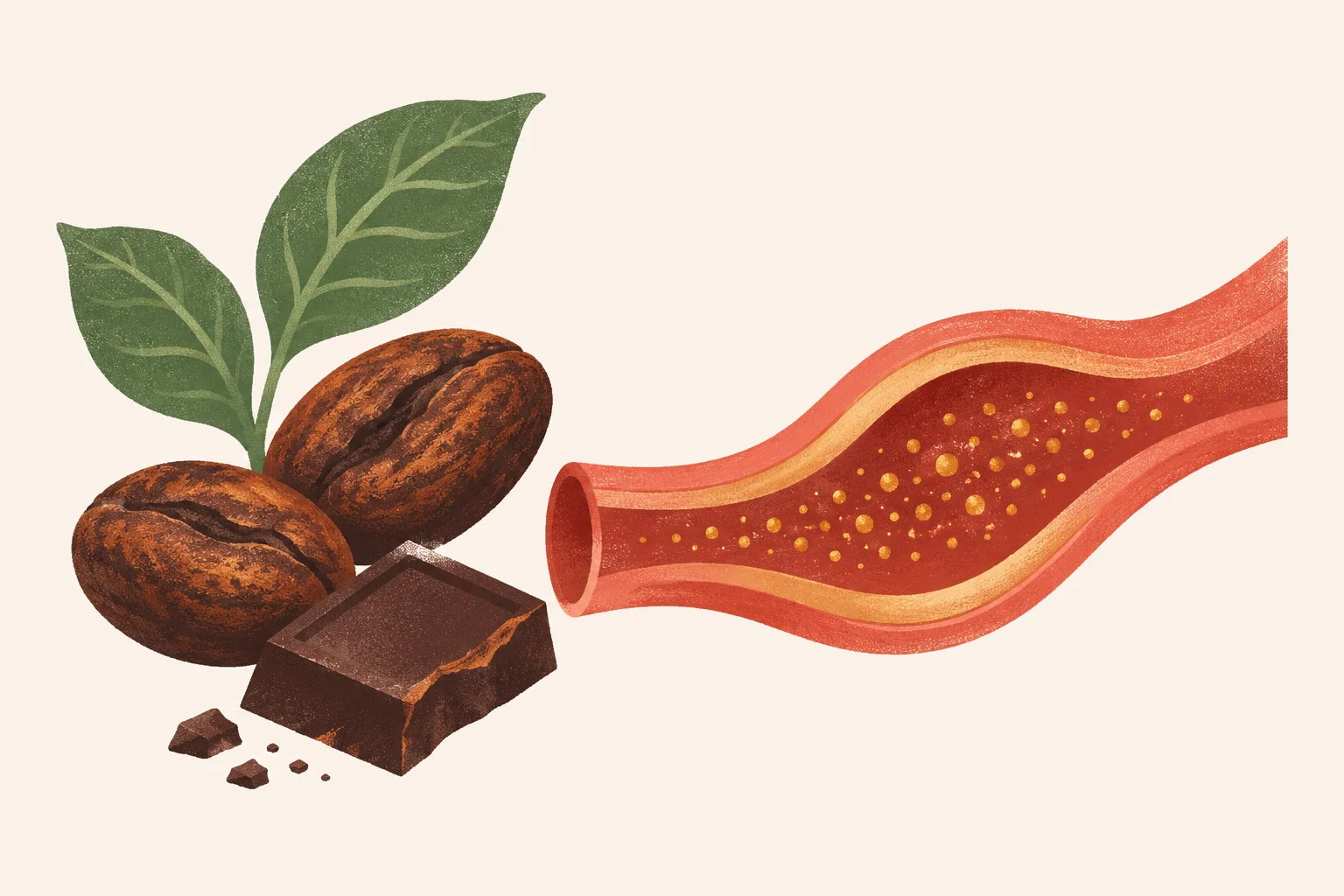
Inside your arteries, the inner lining (the endothelium) uses an enzyme called endothelial nitric oxide synthase, or eNOS, to make nitric oxide gas. Epicatechin increases eNOS activation and slows down the enzymes that break nitric oxide apart. As nitric oxide diffuses into the smooth muscle wrapping your arteries, those muscle fibers relax and the vessel widens.
A 2019 systematic review and dose-response meta-analysis of randomized controlled trials in Food & Function found that cocoa flavanol intake significantly improved flow-mediated dilation, with peak vascular response clustering around 500 to 700mg of total flavanols (roughly 80 to 95mg of epicatechin). [1]
Does that blood flow reach the brain?
Yes, and you do not have to guess because researchers have measured it inside MRI scanners.
In a 2015 double-blind, placebo-controlled crossover trial published in Psychopharmacology, healthy older adults drank a high-flavanol cocoa drink (494mg total flavanols) or a matched low-flavanol control before arterial spin labeling MRI scans. Two hours after the high-flavanol dose, resting cerebral blood flow rose significantly in the anterior cingulate cortex and the central opercular cortex, regions tied to attention and executive processing. [2]
The effect is acute and reversible, not a permanent re-wiring from a single square. Think of it like a two-to-four-hour window of cleaner perfusion, similar in timing to a morning walk, without the jittery vasoconstriction that high doses of caffeine can trigger.
| Cocoa type | Typical flavanol retention | Back-label clue | Taste and color |
|---|---|---|---|
| Raw or gently roasted cacao | 80% to 100% of bean baseline | “Cocoa mass” or “unalkalized cocoa” | Reddish-brown, bright fruit acidity |
| Lightly alkalized (light Dutch) | roughly 40% to 50% | “Cocoa processed with alkali” | Darker brown, milder bitterness |
| Heavily alkalized (black cocoa) | 10% to 22% | “Processed with potassium carbonate” | Jet black, Oreo-style flat flavor |
| Standard milk chocolate | under 15% | Sugar listed first, low cocoa solids | Sweet, milky, minimal astringency |
Why does Dutch processing strip out the active compounds?
Because flavanols taste astringent. Left alone, natural cocoa is slightly acidic (around pH 5.3 to 5.8) and has a sharp bite on the back of the tongue.
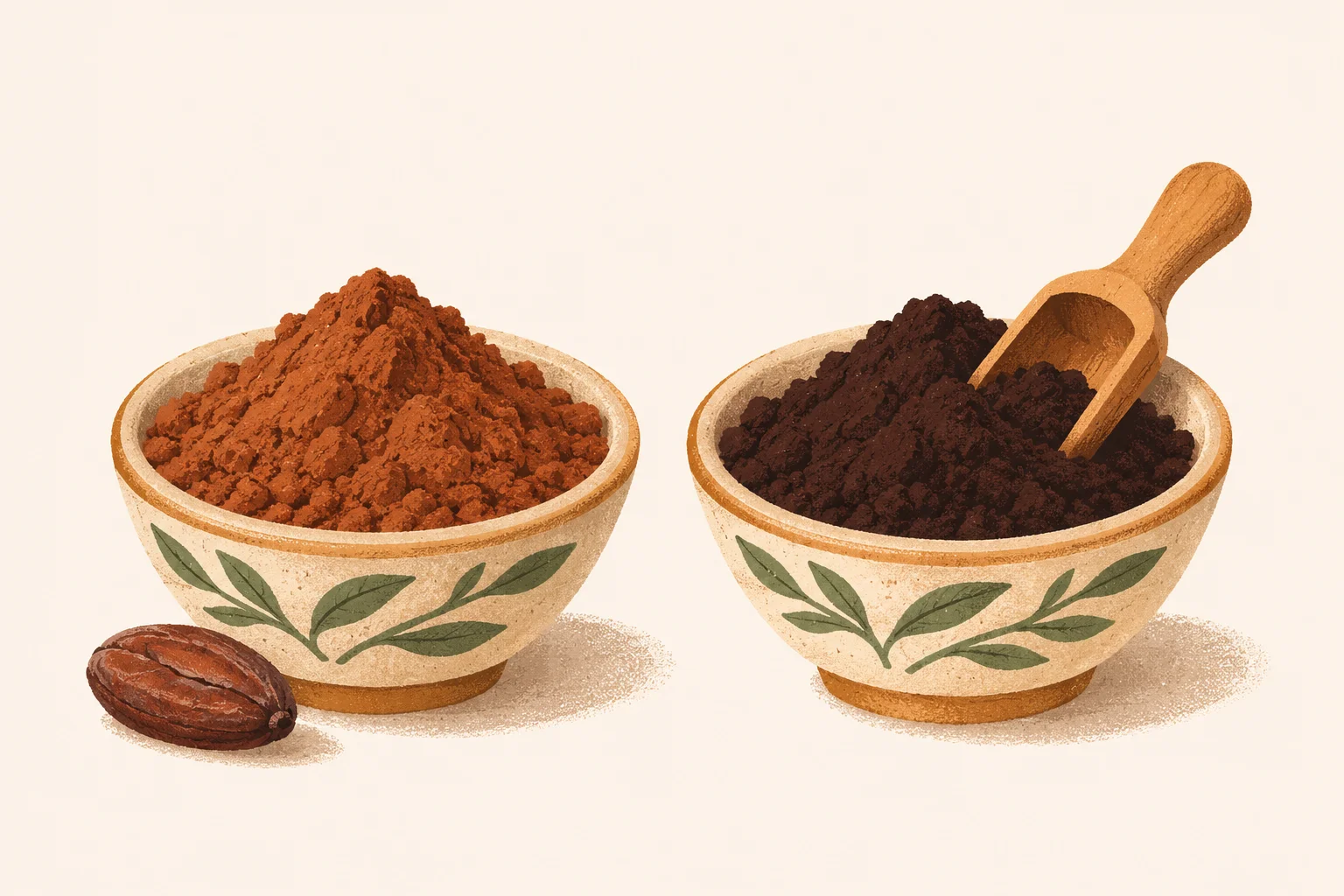
Confectionery factories wash cocoa nibs or press-cake with an alkaline potassium carbonate solution to raise the pH toward 7 or 8. That darkens the bar to a rich mahogany color and smooths out the bitterness, which shoppers mistakenly associate with higher cacao purity.
A 2008 chemical analysis in the Journal of Agricultural and Food Chemistry tested commercial cocoa powders across light, medium, and heavy alkalization. Light alkalization removed roughly 60% of total flavanols; heavy alkalization wiped out 88% of them, with monomeric epicatechin dropping fastest. [3]
Why does the sugar in a 70% bar pull the other way?
Do the math on a 70% bar. Seventy percent is cocoa mass plus added cocoa butter. Almost all of the remaining 30% is refined sucrose. A 40g portion hands you 12g of table sugar in five bites.
When blood glucose spikes rapidly, endothelial cells generate superoxide radicals that scavenge nitric oxide before it can relax the vessel wall. You end up eating cacao for epicatechin while washing it down with the exact glucose excursion that dampens eNOS output.
When we formulated our own dark chocolate batches at BLANK, that contradiction was the first thing on the whiteboard. Keeping the cacao unalkalized preserves the natural epicatechin bite, and swapping cane sugar for a zero-glycemic monk fruit and erythritol matrix keeps post-meal glucose flat while cocoa butter carries the snap.
How to buy dark chocolate that still works
If you are eating dark chocolate for vascular or cognitive support rather than just dessert, three label checks take five seconds in the store:
- Skip anything that says “processed with alkali” or “Dutch-processed” in the ingredient list.
- Aim for 75% to 85% cacao solids, or a bar sweetened with non-glycemic sweeteners like monk fruit and erythritol so sugar stays under 2g per serving.
- Time a 20g to 30g square about 90 minutes before deep desk work or an afternoon training session, when plasma epicatechin hits its stride.
Common questions
Does any 70% dark chocolate boost nitric oxide?
Not automatically. Cocoa percentage only tells you the combined weight of cocoa solids and cocoa butter. If the cocoa was alkalized (Dutch-processed) or roasted hard, 60% to 80% of the flavanols can be gone even in an 85% bar.
How much cocoa flavanol do clinical trials actually use?
Most vascular trials see peak flow-mediated dilation around 400 to 600mg of total cocoa flavanols, including roughly 70 to 90mg of epicatechin. Standard supermarket dark chocolate often delivers a fraction of that per 30g serving.
How fast does dark chocolate change blood flow?
In acute human trials, plasma epicatechin and endothelial nitric oxide activity peak about 90 to 120 minutes after ingestion, then return toward baseline over the next four to six hours.
Why does sugar in dark chocolate matter if the cocoa content is high?
A 30% sugar load in a 70% bar still delivers about 9g of refined sucrose per 30g piece. Acute hyperglycemia blunts endothelial nitric oxide production, pulling in the opposite direction of the flavanols you bought the bar for.
Mentioned in this article
 From the shop
Blank@TS Signature Chocolate
The 4-bar signature pack. Brown sugar, cocoa, stevia and monk fruit. The bar the whole build is modeled on.
See it →₹100